What counts as visible
A star is up when it’s at least 10° above a flat horizon and the Sun is at least 6° below it, so the sky is dark enough to see it. The guide checks in five-minute steps.
See the real sky above you from your place and time, find any star or constellation, and check when a star is up. It works in your browser, with no account.
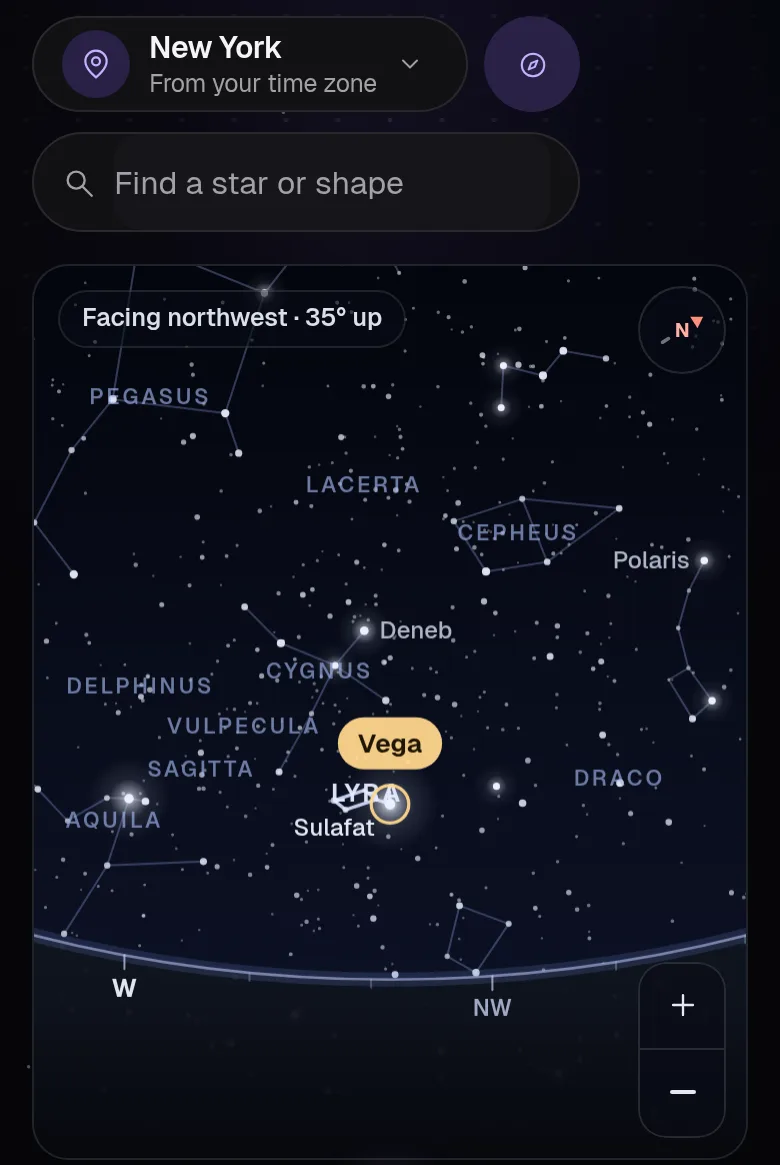
The atlas draws the sky from your place and time: the horizon and the ground, compass points along the edge, and about 2,900 stars down to magnitude 5.5. Its colour follows the Sun through day, twilight and night, with the Sun and the Moon in place and the Moon in its current phase.
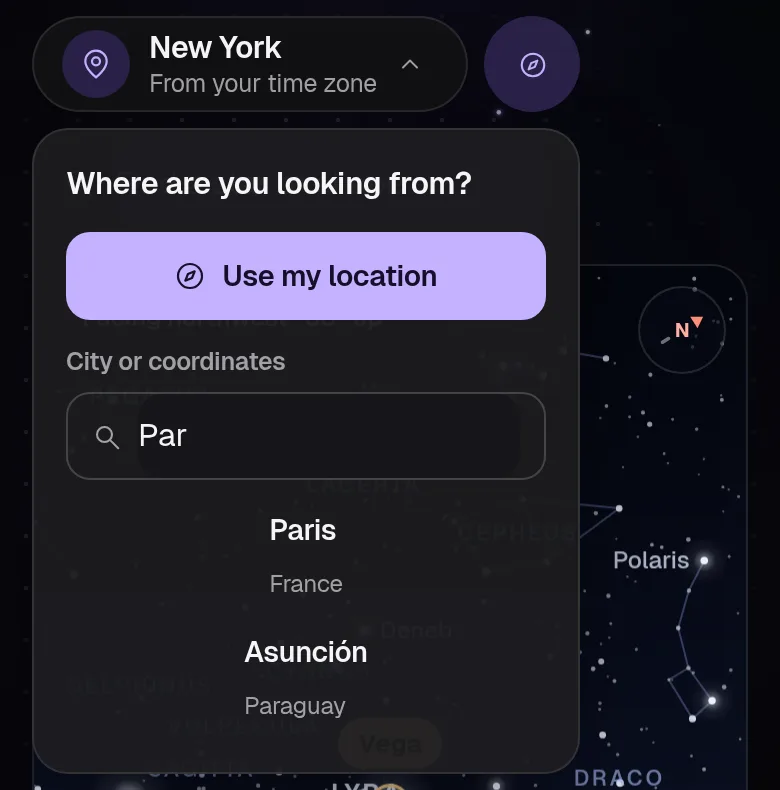
The atlas uses your device’s location when you allow it. Until then, it starts from the city your time zone is named after. Search about 200 cities, or type a latitude and longitude, to look from somewhere else.
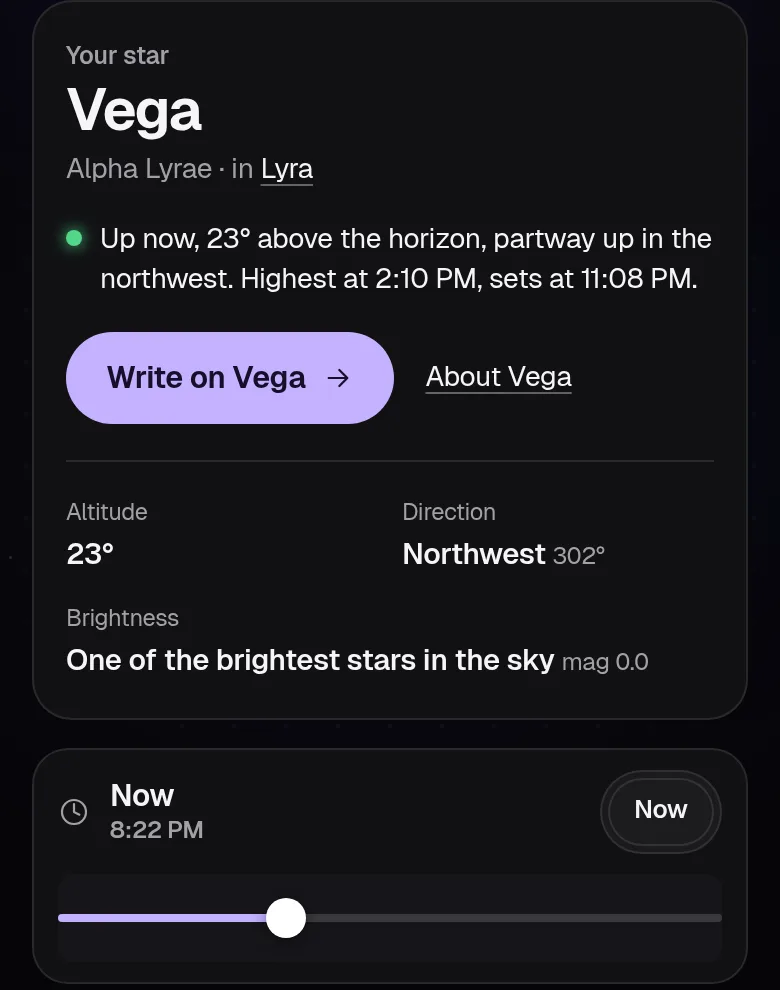
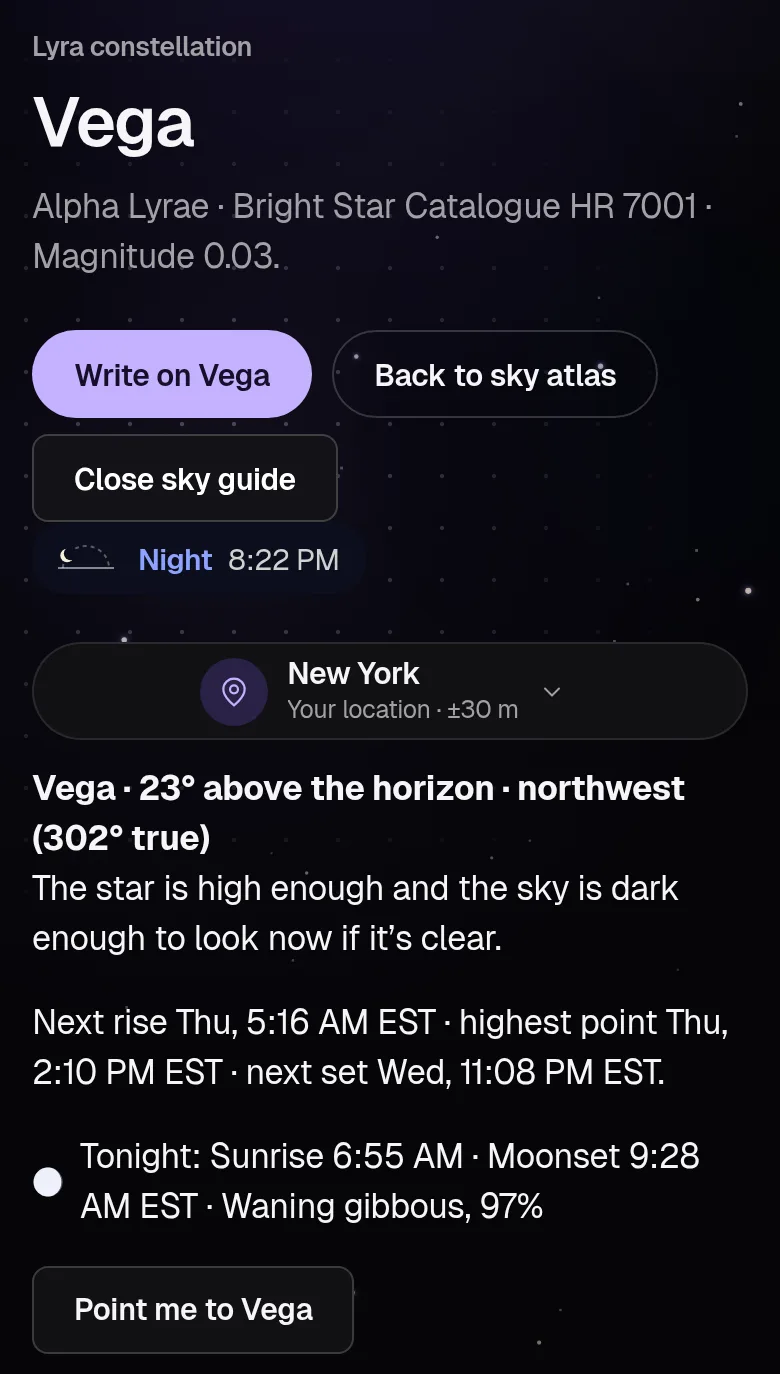
Vega is chosen to start, with a gold ring and its constellation highlighted. When it’s out of view, a marker at the edge points the way, like “Vega · below horizon”. The star card says where it is now and when it rises, peaks and sets.
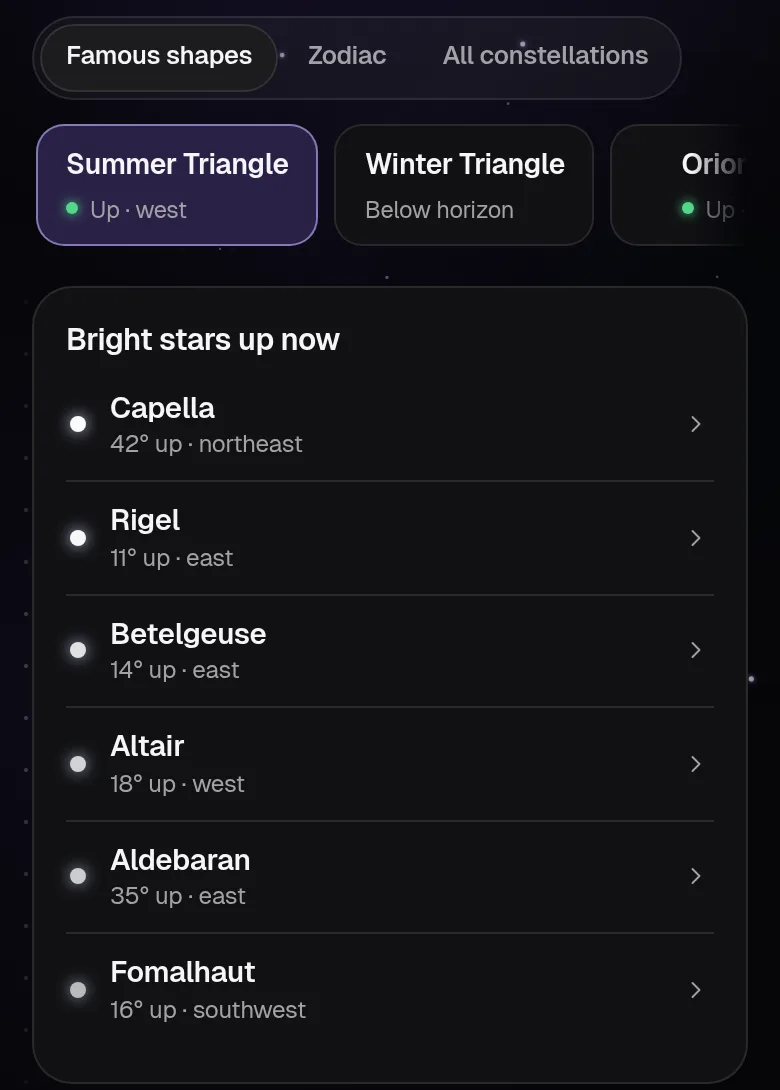
One field, Find a star or shape, searches star names and constellations. Or browse the tabs: Famous shapes, Zodiac and All constellations. Each shape says whether it’s up and where, and picking one turns the view to it.
A star’s page shows its designation and brightness, and the sky guide: how high it is and which way to face, a suggested time to look in the next 48 hours, and when it rises, peaks and sets.
Star pages and Sky Letters use the same rule.
A star is up when it’s at least 10° above a flat horizon and the Sun is at least 6° below it, so the sky is dark enough to see it. The guide checks in five-minute steps.
On a star’s page, the sky guide looks 48 hours ahead and suggests a time when the star is up in a dark sky, or tells you there isn’t one from where you are.
Whenever its star is above the reader’s horizon. There’s no time to choose when you write one.
These are estimates. They assume a clear sky and a flat horizon, and clouds, trees, buildings and city lights can hide a star.
Vega, Deneb and Altair shine on northern summer and autumn evenings, and they make an easy first find.
Lyra, the lyre
The fifth-brightest star in the night sky. About 14,000 years ago it was the North Star, and in about 12,000 years it will be again.
Find Vega tonightCygnus, the swan
One of the most luminous stars you can see with the naked eye, shining tens of thousands of times brighter than the Sun.
Find Deneb tonightAquila, the eagle
Spins so fast, about once every nine hours, that it bulges at its equator. Visible from almost everywhere on Earth.
Find Altair tonightDistances are published estimates, and Deneb’s is especially uncertain. StarLetter doesn’t name or sell stars. Linking a letter to one is a symbolic gesture.
No. The atlas and the star pages work without signing in. You need an account to send a letter.
No. Your location stays in this browser, and the sky is worked out on your device. Without location access, the atlas starts from the city your time zone is named after.
Yes. Move through search results with the arrow keys and choose one with Enter. The zoom and Face north buttons, the time controls, the shape lists and Bright stars up now all work from the keyboard.
The atlas draws about 2,900 stars, and a Sky Letter can use any star in the full catalog, about 9,100 in all. Constellation Stories use the 102 named stars that are built in.
The atlas shows where a star is, not whether you can see it. Daylight, clouds, trees, buildings and city lights can all hide it. Seeing the star is never needed to read a letter.
On iPhone, yes: the app adds camera directions to your star. The web atlas is a sky map. Read about StarLetter for iPhone.
Open the atlas and see where Vega, Sirius, Polaris and the rest of the sky are right now.